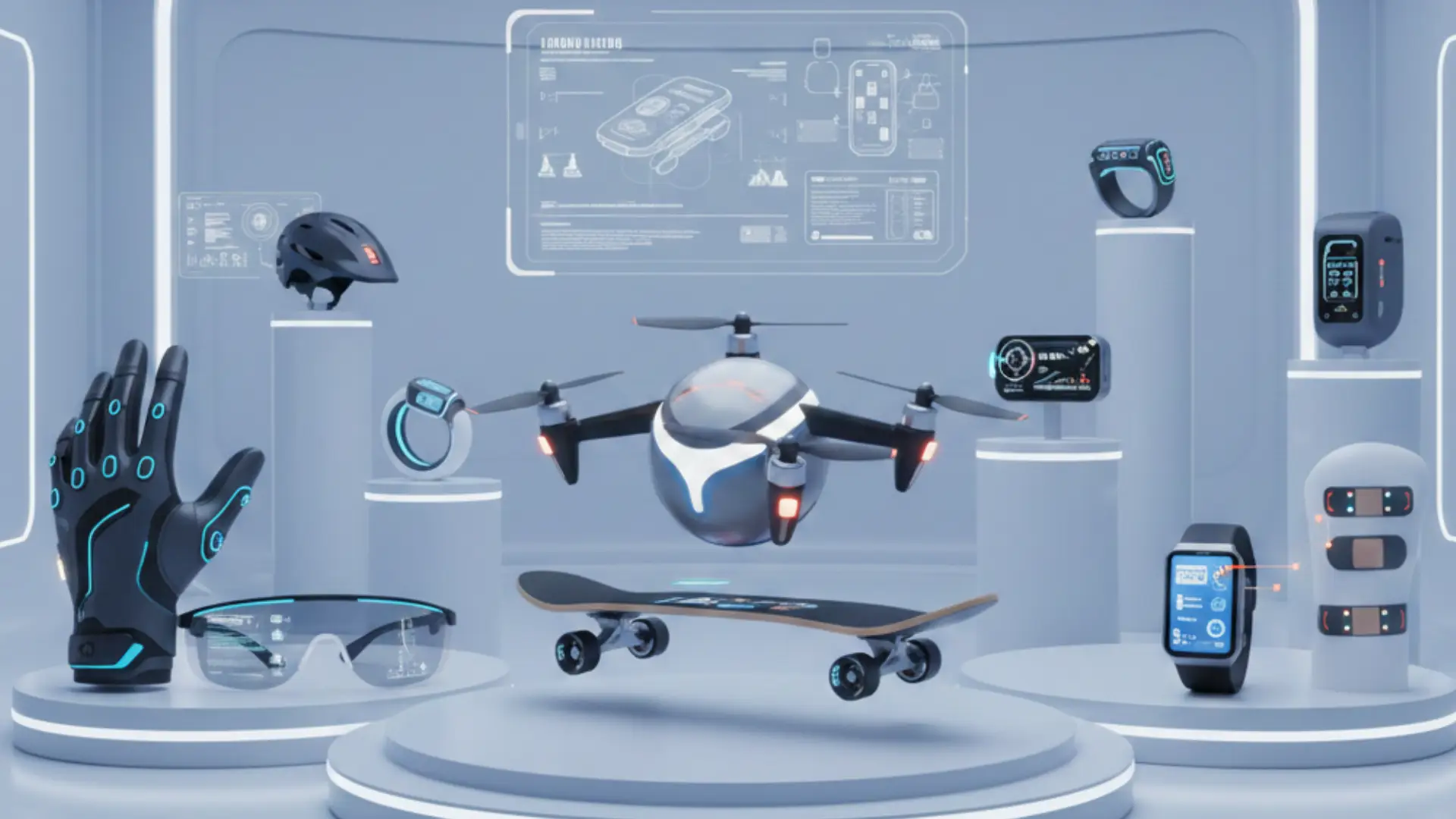
The most interesting 2026 tech gadgets aren’t about bigger screens or faster chips. The real shift is happening somewhere else: how we interact with devices in the first place. In the near future, “control” won’t mean tapping a display or barking commands at a voice assistant. It might mean a jaw clench, a micro head tilt, or a passive health signal your body gives off without you thinking about it.
That’s not a far-off concept demo. These are real products launching this year, and a few of them already grabbed major industry awards. Some of this tech feels borderline supernatural, until you realize it’s built on sensors, pattern recognition, and clever engineering rather than magic.
Below are ten 2026 tech gadgets pulled directly from the transcript, with what they do, who they’re for, and where the hype ends and reality begins.
1) Naqi Neural Earbuds: Thought-Like Control Without Voice or Hands
The Naqi Neural Earbuds won the CES 2026 Best Innovation Award, and this time it’s not just a shiny sticker for incremental upgrades. This is a new input method.
Despite the name, they’re not “earbuds” in the usual sense. They’re a neural interface that turns tiny unconscious movements into commands. Clench your jaw and your lights turn on. Tilt your head and the thermostat adjusts. No voice, no screen, no hands.
It works through air pressure sensors that read micro-gestures and pressure changes inside the ear canal, combined with facial micro-gesture detection. In normal human language: it interprets subtle physical signals as intentional inputs.
This has a huge accessibility angle. Controlling computers, smart homes, wheelchairs, and connected devices without hands or speech isn’t a gimmick. For people with limited mobility, it’s a genuinely new way to interact with technology without assistance.
Reality check: it’s expensive (over $1,000), it has a learning curve, and first-gen hardware always comes with quirks. But when the upside is “operate your digital world without speaking or moving your hands,” those limitations start looking manageable.
2) Doogee BoneAir Swim: Music Underwater Without Bluetooth Problems
Bluetooth underwater has always been a dead-end. Swimmers have basically had two options: train in silence or give up and accept that music is a land activity.
The Doogee BoneAir Swim solves it with bone conduction, transmitting vibrations through your cheekbones to your inner ear while underwater. Then it switches to air conduction above water.
The smartest part: it doesn’t rely on your phone. It has 32GB of storage built in, so you load your music once and forget Bluetooth entirely. That’s the real win. When you’re swimming laps, your phone is useless anyway.
It’s not a general-purpose headset. If you don’t swim regularly, you won’t use it. But if swimming is part of your routine, this finally fixes a problem people have tolerated for way too long.
3) Hypershell X Ultra Exoskeleton: Making Hills Feel Flat
This looks like a hiking backpack. It’s actually a personal exoskeleton that reduces physical effort by 63% and won a mobility tech award.
The Hypershell X Ultra uses AI to detect walking patterns in real time and assists your hips with synchronized motorized support. In practical terms, it makes climbs feel flatter and long distances feel shorter.
It uses dual motors and motion recognition to match your stride automatically. It adapts as you walk, assisting only when needed, not constantly. That’s why it doesn’t feel like you’re being pulled forward. It feels like your legs suddenly have more endurance.
Key numbers from the transcript: 63% reduction in hip flexor strain, around 2kg total weight, and up to 60km of assisted range per charge. It recognizes walking, climbing, and descending, adjusting on the fly without manual input.
Reality check: it’s expensive (around $2,000). Setup takes a few minutes. And yes, there’s always a risk of dependency if you rely on assistance constantly. Used intentionally though, it’s not replacing effort. It’s redistributing it.
4) PF-Sweat Patch: Biomarkers Without Blood Tests
Routine health monitoring is inching toward a future where blood tests aren’t the default for everyday insight.
The PointFit sweat patch analyzes biomarkers from your sweat, including lactate, cortisol, and glucose-related signals, the kinds of things that typically mean lab work and needles. Instead of a snapshot every few months, this gives ongoing insight while your body is actually under stress.
The patch uses a nano-membrane sensor system validated against clinical blood tests. In other words, it’s not guessing, it’s measuring.
The first version focuses on lactate. That matters because lactate tells you when your body shifts from efficient energy use into fatigue. For athletes, this means no more guessing training zones. You see the threshold as it happens.
Limits: it only works when you’re sweating, patches aren’t reusable, and it needs time to prove long-term consistency. But the direction is clear: health data is moving from occasional lab visits to continuous passive monitoring.
5) AUKEY MagFusion Ark: Wireless Charging That’s Actually Wireless
After sweat biomarkers, we get phone charging. Humans.
The AUKEY MagFusion Ark is a modular wireless charging system with three detachable battery spheres. Each sphere has a 6700mAh battery and a 25W wireless charging pad. Dock them and they recharge. Undock them and they become portable wireless chargers you can take anywhere.
Total capacity is 20,100mAh with six charging surfaces: three fixed, three mobile. What makes it work is active cooling inside each sphere, allowing higher wireless speeds without throttling.
Trade-offs: heat, a bit of fan noise, and a base station that takes up real desk space. Estimated price is $450–$500. Still, it solves the fundamental problem with wireless charging: you’re no longer tethered to one spot.
6) HyperSpace Trackpad Pro: Windows Trackpads Finally Catching Up
Windows users have been jealous of Mac trackpads for years. The HyperSpace Trackpad Pro aims to end that.
It runs at a 240Hz polling rate, so cursor movement feels instant. It supports full ten-finger multi-touch, meaning native Windows gestures work as intended. It uses piezo haptics so the entire surface clicks evenly, with no dead zones.
The deep-click system is clever: light pressure for standard click, deeper pressure for right click, even deeper for custom actions. Everything is customizable through app-specific profiles for tools like Adobe Premiere, AutoCAD, and Blender. Price: around $150.
7) Shokz OpenDots ONE: Audio Without Losing Awareness
Most earbuds still assume you want to block the world out. Sometimes you don’t.
The OpenDots ONE uses a clip-on open-air design that sits just outside your ear canal instead of sealing it off. You can listen to music, calls, or podcasts while still hearing traffic, people, or announcements.
Battery life is built for daily use: up to 10 hours per charge, 40 hours total with the case. It’s IP54 rated for sweat and rain. The trade-off is bass. You won’t get sealed-earbud thump, but voices remain clear and music still sounds surprisingly full.
It also has automatic left-right detection: you clip them on and they figure it out.
8) DJI Osmo Pocket 4: A Real Camera Made Portable
The Osmo Pocket 4 is what happens when DJI stops trying to make action cameras smaller and instead makes real cameras portable.
It’s 35% lighter than the previous model at 116g, while introducing the world’s first dual camera system in a pocket gimbal: a standard wide lens plus a vertical lens stack that provides optical zoom without wrecking image quality.
It shoots 6K at 30fps and includes variable aperture that acts like a built-in ND filter. The square sensor format is a big deal because most cameras crop vertical video from horizontal sensors, losing quality. This shoots native 4K vertical, perfect for social platforms without compromise.
Launch is January 2026. Likely drawbacks: early software bugs and a price around $500.
9) Insta360 Flow 2 Pro: Making Your Phone a Production Setup
The Flow 2 Pro turns your phone into a stabilized, tracked, production-ready camera without extra gear.
The standout feature is Apple Dock kit integration, meaning it works directly with the iPhone native camera app, not just third-party apps. Face tracking, subject tracking, and framing are handled at the system level.
Deep Track 4.0 locks onto a subject and keeps them framed even at 15x zoom, where most phone gimbals fall apart. It includes a built-in teleprompter, quietly making it one of the best tools for creators, presenters, and streamers who want to stay on script without breaking eye contact.
It folds into an all-in-one gimbal, tripod, selfie stick, and power bank. Price is $159. The downside is complexity. It has a lot of features, and if you want “simple phone-only shooting,” this adds steps.
10) CERAGEM Home Therapy Booth 2.0: The Biggest Shift in Home Wellness
The most extreme 2026 tech gadgets aren’t about speed or cameras. They’re about home health care becoming a fully adaptive system.
The CERAGEM Home Therapy Booth 2.0 is a private wellness pod using AI, computer vision, and multiple sensors to provide personalized stress relief and mental health support. Before you step in, it scans heart rate, breathing, skin temperature, and stress levels using contactless sensors like radar, micro-motion detection, thermal imaging, and edge AI processing.
Then it adjusts temperature, oxygen concentration, lighting, sound, and aromatherapy in real time based on your readings. The most significant piece is an AI mental coach that provides natural language conversation and personalized mental health guidance in complete privacy, with local processing so your sensitive data never leaves the booth.
Reality check: likely $10,000+ and it requires space. But the implication is huge: personalized support at home, 24/7, without waiting rooms or social friction.
What These 2026 Tech Gadgets Really Signal
The theme across these 2026 tech gadgets is a shift away from screens and toward frictionless interaction: micro-gesture control, assisted movement, continuous health signals, and environments that adapt to you.
It’s not about turning humans into superheroes. It’s about extending what people can already do, making daily life easier, more measurable, and in some cases, more accessible.
And the only real question is the one the transcript ends on: will we be ready for tech that personal?